
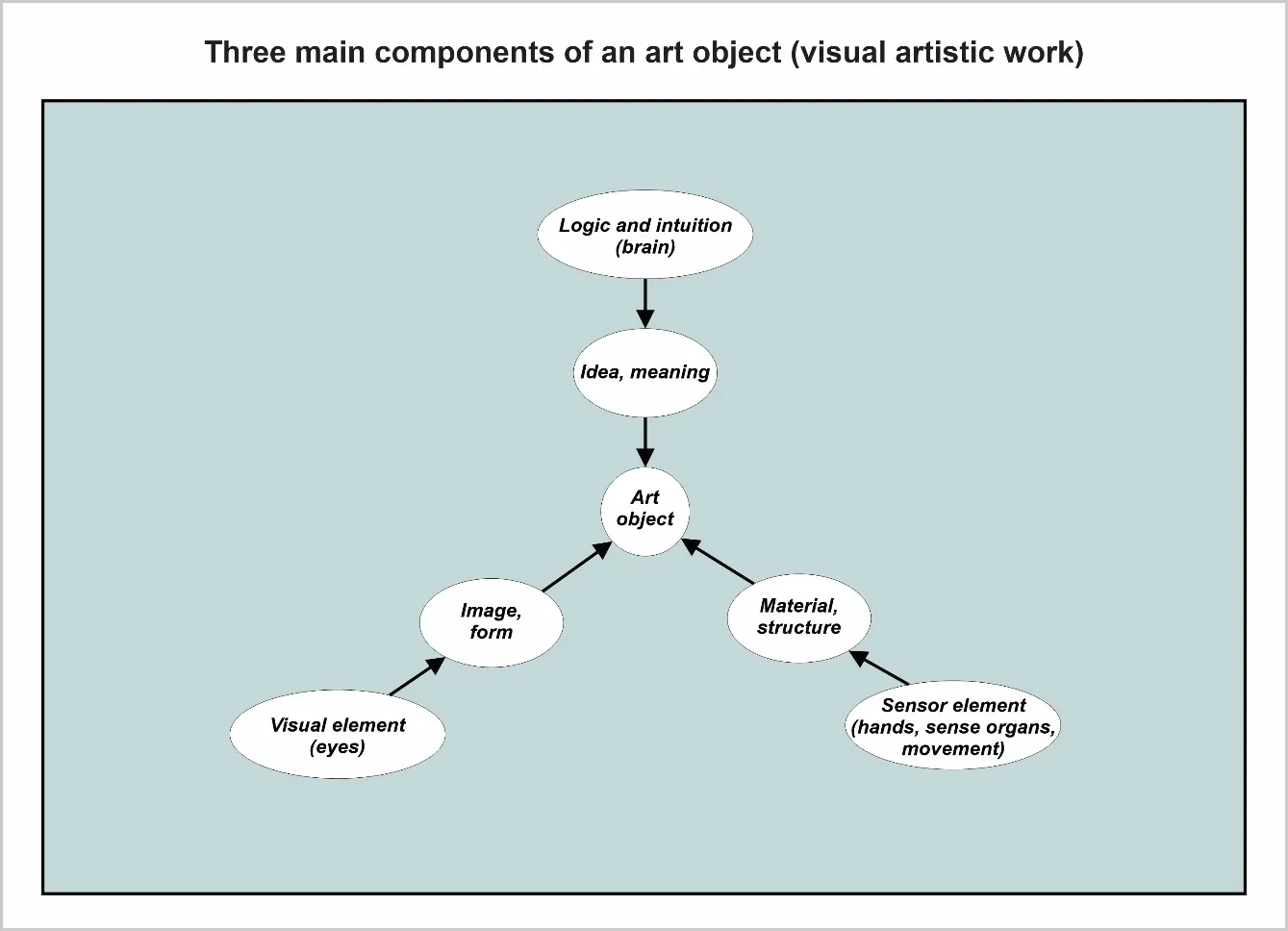
A work of art is born at the intersection of three forces: this is a visual, sensory and logical principle. The role of sensory and visual principles is well known. The effect of the verbal and logical, ideal and semantic component is less obvious. Thus, A. G. Rappaport notes: «Perhaps it is precisely the lack of experience in the logical study of professional thinking that has led to the fact that it has become customary that verbal forms of thought are underestimated and thinking in images is set in opposition to them» [67]. Next, we will try to substantiate the importance of the word and conceptual logic in architectural form generation – it is no less than the importance of three–dimensional images as such and materials / structures.
The Basis of the Method Is a Dialectical Triad, a Synthesis
When we think of modern architecture, we are in two minds: from the edge that it can do anything (conquer gravity and explore other planets) to the edge that it is a thing of the past, when one can hear that «there is no longer a recognized formal concept», but there is a «chimerical consciousness», and «it cannot create a form, it does not believe in it» [68]. We can say that the destiny (as the path, not the fate) of architecture is the destiny of form. Architecture exists as long as there is a form and there is a will to create a form, and architecture degenerates into something else (for example, a mirror or a screen) when the concept of the form is devalued, ceases to be a worthy task, and is replaced by a game or imitation.
Two forces inspired the author to propose a discussion to dear readers – the love of architecture and the philosophy of Aleksei Fyodorovich Losev. The thoughts outlined here run the risk, in the words of Grigory Revzin, of remaining marginal «both in relation to architectural studies, which are not engaged in philosophy, and in relation to philosophy, which is not interested in architectural studies [italics mine Yu.P.]» [29, 7].
But there is a third area for which the thoughts of this book were honed – pedagogy: pre-university training of students – future designers and architects, and teaching architectural composition (propaedeutics) to first-year students of architectural design colleges and universities. The ultimate goal of this work is of an applied nature: it is intended to introduce form-generating architectural composition into the practice of teaching creative art.
N. F. Metlenkov draws attention to the fact that «creativity as a philosophical and psychological concept has not found a place in logic. Therefore, the theory of teaching creativity has not been worked out either. Project creativity is still taught in artisanal manner, only in the process of joint project activity of the teacher and the student» [35, 427]. The material of the proposed essays seeks to fill this gap and form a theoretical core for the application of the constructive dialectical method in architectural propaedeutics and at the design stage aimed at the compositional and artistic solution of the image of the future building.
The practical results of applying our method – selected works of the author and his students – are experimental in a positive sense of the word. According to A.P. Kudryavtsev, «it is necessary to look for all the latest methodological tools; there is no other way to new methodological tools except the path of experimentation; without experimentation, one cannot be in pedagogy today, that’s why one must experiment, and experiment very actively, in all areas of architectural education» [36, 369].