
A. F. Losev’s philosophy reveals a dialectical type of thought, different from formal logic and binary schematism. The key concepts in our discussion are the dialectical triad and synthesis. In its most simplified form, the dialectical triad manifests itself as a thesis, antithesis and synthesis [7, 116]. Thesis and antithesis are any two opposite concepts, their opposition is overcome in synthesis. Dialectics requires that «two opposites, despite their substantial specificity and independence, merge in a synthesis, where it is no longer possible to distinguish these two opposites. The synthesis represents a completely new and original quality, but it nevertheless, remains a condition for the possibility of emergence of the two original opposites from it» [9, 56]. Synthesis becomes such a union of two opposite principles, in which they do not only lose themselves, but also acquire a new quality, unknown to them before synthesis: «the whole is such that, although it consists of parts, it does not reduce to these parts at all, but there is some new quality, thanks to which separate, mutually isolated things turn into just certain parts of just the certain whole. In other words, obtaining a new quality from two other qualities that have nothing in common is simply the result of the dialectical unity of opposites» [7, 331].
A. F. Losev’s concept of the whole as a synthesis of its parts is close to Father Pavel Florensky’s concept of the form: «The concept of the whole, «which is prior to its parts,» and which, therefore, determines the composition of its elements. And this is the form» [15, 18]. Summarizing, we can say that the whole is a singularity presented as a synthesis of its parts and properties, irreducible to their sum, and manifested in a form (eidetic image). In the Losev semantic field, «self-identical difference», «coordinated separateness», and «single separable integrity» are similar concepts. In composition, it is necessary to give the separateness of forms, and to give their unity, and to coordinate their separateness and their unity as one whole.
It is possible to apply the dialectical triad to the construction of geometric forms, and to consider forms and their parts and qualities within an architectural composition as theses, antitheses and syntheses. A similar concept is the term «contrast», well-known in architectural propaedeutics. Contrast is the juxtaposition of thesis and antithesis, without combining them in synthesis (Fig. 1).
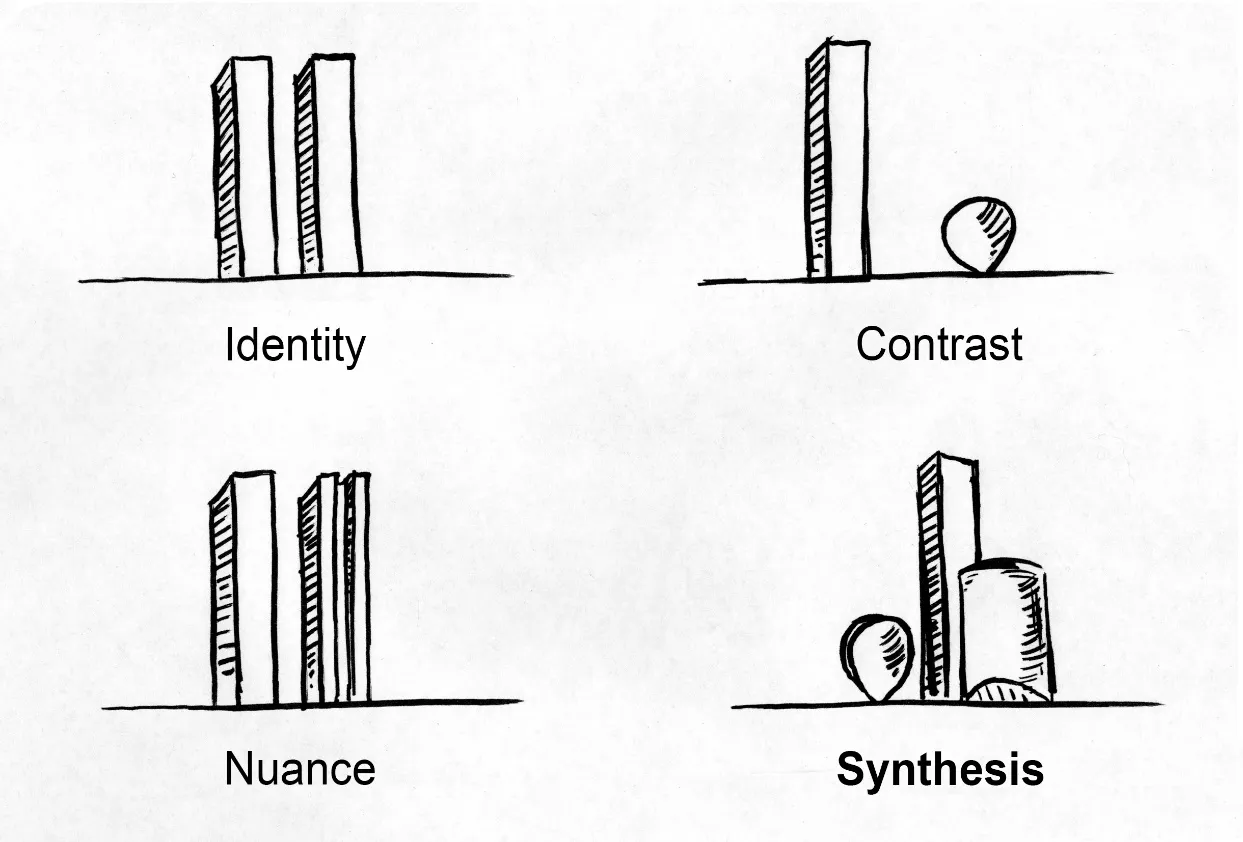
Fig. 1
In relation to the architectural field, the concept of synthesis undergoes, in A. F. Losev’s terms, a meonal, other-worldly change. In the material world, in which architecture is created and lives, synthesis may not be given in full force, as in the purely conceptual field, but partly as a combination of opposites, when parts of forms and their properties are combined in a new form. In this respect, synthesis acts as an «in-between» between opposites, but nevertheless its unifying role does not lose its significance.