
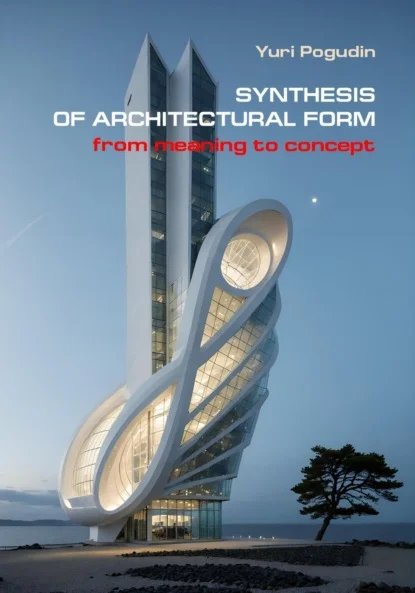
Юрий Погудин
Synthesis of Architectural Form. From Meaning to Concept
Life is a controversy waiting for synthesis
A. F. Losev
Dedicated to my family:
my wife Zoe and daughter Taya,
my mother Lyudmila, my father Alexander
and my sister Nina
Preface to the English edition
Dear readers, the translation of this book was performed by a friend of our family, Anna Kanunnikova. I am deeply grateful to her for the work.
The author hopes that the proposed direction will contribute to new architectural searches and discoveries.
September 14, 2025
Preface
Dear readers, I hope that this book will not only be read by you, but also will help you to create expressive architectural compositions.
Realities of the world that is changing before our eyes give rise to new requirements to competences of modern specialists. The active implementation of neural networks in the creative work of artists, designers, and architects brings linguistic and verbal thinking into focus, with its diverse connections with two-dimensional and three-dimensional forms. The connection between words and forms is the point that brings forth the results of the co–creation of human and artificial intelligence. It is in this vein that the author has been conducting research for more than 9 years, the results of which are presented in this book. It outlines the basic principles of communication between verbal/conceptual and figurative/spatial forms of thought. In our Archineo studio, students learn to create new architectural forms using a complex verbal and visual method in a series of certain exercises. A word and an image are two wings. A word is an impulse to create an image. The «clip consumption» of visual content should be replaced with the development of conceptual thinking in its connection with images, space and form. This is the only way a thinking creator can avoid becoming a mere appendage to neural networks, but enter into a co-creative resonance with them. Neural networks will enhance his creative potential, and the person will unlock their advanced capabilities.
The set of reflections in these essays provides a theoretical basis for the harmonious co-creation of human and artificial intelligence in the field of innovative architectural shape generation (form creation, morphogenesis). This book contains no blueprints for using neural networks, but there is something more: it highlights a number of issues on the use of verbal and philosophical methods of thinking in architectural morphogenesis, which is of practical importance both in independent creative search and in the generation of concepts in neural networks.
The author first conceived the idea of combining philosophy and architecture while studying at the St. Petersburg State University of Architecture and Civil Engineering at the Faculty of Architecture. While studying the basics of spatial composition, the history of fine arts and architecture, I first came across the early works of the great Russian philosopher Aleksei Fyodorovich Losev. The term paper in philosophy titled «Architecture as a Subject of Philosophy» (2001) marked the beginning of essays on architectural composition. In the following five years, the preliminary general theoretical part, «The Dialectic of Architecture» (2006), was written. After a few years, thanks to the support of Viktor Petrovich Troitskiy, a senior researcher at the Losev House1, I continued to develop a system of architectural propaedeutics, both theoretical and practical, based on the results of architectural design lessons that I have been giving for more than three years. The proposed methodological principles are applied by my students in their architectural and artistic projects (examples are presented in the final section). Some of them became winners in architectural categories of creative contests for children and youth.